| INNOVATIVE TOOLS & TECHNIQUES FOR COMMUNICATIVE SANSKRIT LANGUAGE IN INDIA – Article by Dr. Ashutosh Pareek, Author, Educator & Sanskrit Promoter |
Abstract
National Education Policy 2020 has accepted the importance of Sanskrit language, but there is a need to be comprehensively prepared for the future Sanskrit generation and Sanskrit education. Innovation in Sanskrit is the key to this, but there are many obstacles in the success of these innovations, which require determination with skill to overcome them. Sanskrit is the precious gem of the past and the key to the future. No one doubts its scientificity and utility in the present era from a linguistic point of view, but still our educational system has often failed to take effective steps for Sanskrit teaching & learning.
Index Terms
Language Skills, Speak Sanskrit, New Sanskrit Applications & Courses, Sanskrit Villages, NEP 2020.
I. INTRODUCTION
Sanskrit has versatility of expression, amazing power to create new words, ability to meet the challenges and needs of the future, incredible flexibility and utility in this age of science and technology. Innovative ideas in education are making pedagogies effective, collective & attractive. Sanskrit has also developed some new forms of teaching learning tools. These tools are so effective to create attraction in new era.
II. METHODS
In this paper researcher examined various Sanskrit applications, Websites & Courses offered for Sanskrit learners. Collected data of Sanskrit Villages & analyzed and checked reality & effectiveness.
III. Results
Innovative ideas to learn Sanskrit implemented in our education system & society. Sanskrit Baharati, Lok Bhasha Prachar Samiti, Central Sanskrit University etc worked effectively in so many aspects to spread Sanskrit in the society. Today there is a need for radical change in the fundamental ideology and methods of Sanskrit teaching. This change is capable of making innovations in Sanskrit widespread and reaching every heart. Through this research paper, an attempt will be made to put present scenario & upcoming future in front of scholars with the utility of Sanskrit-innovations in the implementation of the NEP 2020.
IV. Discussion
Sanskrit, as one of the oldest existing languages, has contributed immensely towards shaping the history of India’s culture and civilization. But even today, its beauty, logic and almost flawless structure bring a universal appeal. The proper use of Sanskrit in everyday life can endow its user with enhanced creativity and imagination, clearer thinking, deeper concentration and better memory. Not only does Sanskrit help students to gain self-confidence and clarity in speech, language skills and logical thinking, it also enhances their skill and understanding in other, seemingly unrelated subjects like science, mathematics and computers.
Moreover, Sanskrit generates a deeper awareness in students of themselves and everything around them. These are timeless qualities. Sanskrit’s versatility of expression, its amazing power to create new words, its ability to meet the challenges and needs of the future, its incredible flexibility, and its utility in this age of science and technology…. Innovative ideas in education are making pedagogies effective, collective & attractive. Sanskrit has also developed some new forms of teaching learning tools. These tools are so effective to create attraction in new era.
Today Sanskrit has become the official language of Uttarakhand1 and Himachal Pradesh2. Sanskrit is taught at upper primary, secondary and higher secondary level in many universities, colleges and schools in India. Various programs & schemes are being organized for the promotion of Sanskrit language by various institutions like Sanskrit Bharati3, Lokbhasha Prachar Samiti, Bharat Sanskrit Parishad, Sanskrit Promotion Foundation4 and Central Sanskrit University5 etc.
Wikipedia says- “Sanskrit is a classical language belonging to the Indo-Aryan branch of the Indo-European languages. It arose in South Asia after its predecessor languages had diffused there from the northwest in the late Bronze Age. Sanskrit is the sacred language of Hinduism, the language of classical Hindu philosophy, and of historical texts of Buddhism and Jainism. It was a link language in ancient and medieval South Asia, and upon transmission of Hindu and Buddhist culture to Southeast Asia, East Asia , and Central Asia in the early medieval era, it became a language of religion and high culture, and of the political elites in some of these regions. As a result, Sanskrit had a lasting impact on the languages of South Asia, Southeast Asia, and East Asia, especially in their formal and learned vocabularies.”6
Noble awarded Prof. Amartya sen says- “We live in the present, but that is tiny bit of time, it passes as we talk. The current moment as vivid as it is, does not tell us much about who we are, how we can reasonably see ourselves and where we would place our loyalties if and when we face divisions. Our identities are strongly influenced by the past.”7
After independence, Acharya Narendra Dev had said – “On being independent, our responsibility has increased a lot. It is our duty to give a special place to the study of Sanskrit learning in the curriculum and encourage the work of investigation. There is respect in the world because of the great men of the modern age and because of its ancient culture. It would be a matter of regret if we do not pay due attention to this essential duty and show indifference towards the protection and growth of Sanskrit literature.”8
There are many language experts in India, Who strongly recommend that there is no need to speak or express their thoughts in Sanskrit. We may only try to understand the scriptures & this is sufficient for this era. Educationist like Dr. Raghunath Safaya writes in his book ‘Sanskrit Shikshan’ – “The ability to express ideas or thoughts in simple language (Sanskrit). This objective cannot be stressed enough. Understanding Sanskrit is more important in Sanskrit, not expression. We expect from the student that he/she can study the texts after getting the knowledge of Sanskrit. There is no need to express your original thoughts in Sanskrit.”9
Therefore, there is a need for a comprehensive change in the field of Sanskrit in the present education system, for which the National Education Policy 2020 has paved the way. The emphasis on multilingualism in the New Education Policy 2020 is evident from the use of this word more than 200 times in the entire 66-page document, indicating that the dominance and importance of language has been given utmost in this education policy.10
Sanskrit has its significant place in this multilingualism.11 We have to find answers to the bitter questions of Sanskrit language’s prevalence, utility and future significance.12 That is why meaningful initiative is also needed to give Sanskrit a proper place in the education system. Although millions of students are studying Sanskrit under classes 6 to 8 in the schools of India, but their learning has been limited to the memorization of only a few shlokas and some root-word forms. Will it be enough to learn from the linguistic point of view? If not, today there is a need for a radical change in the fundamental ideology and methods of Sanskrit teaching. In the present era, there are two aspects regarding Sanskrit language-
- That heritage of knowledge embedded in Sanskrit literature, which is an incomparable ocean of universal understanding, life values and which is needed in the present era.
- Status, prospects and problems of the study of Sanskrit language and its literature in the present world.
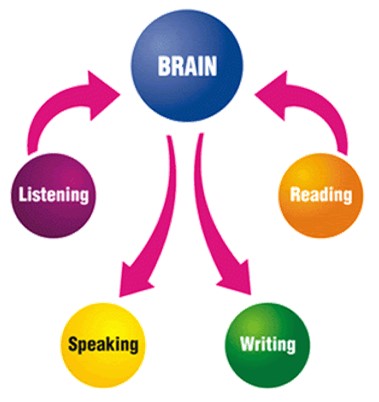
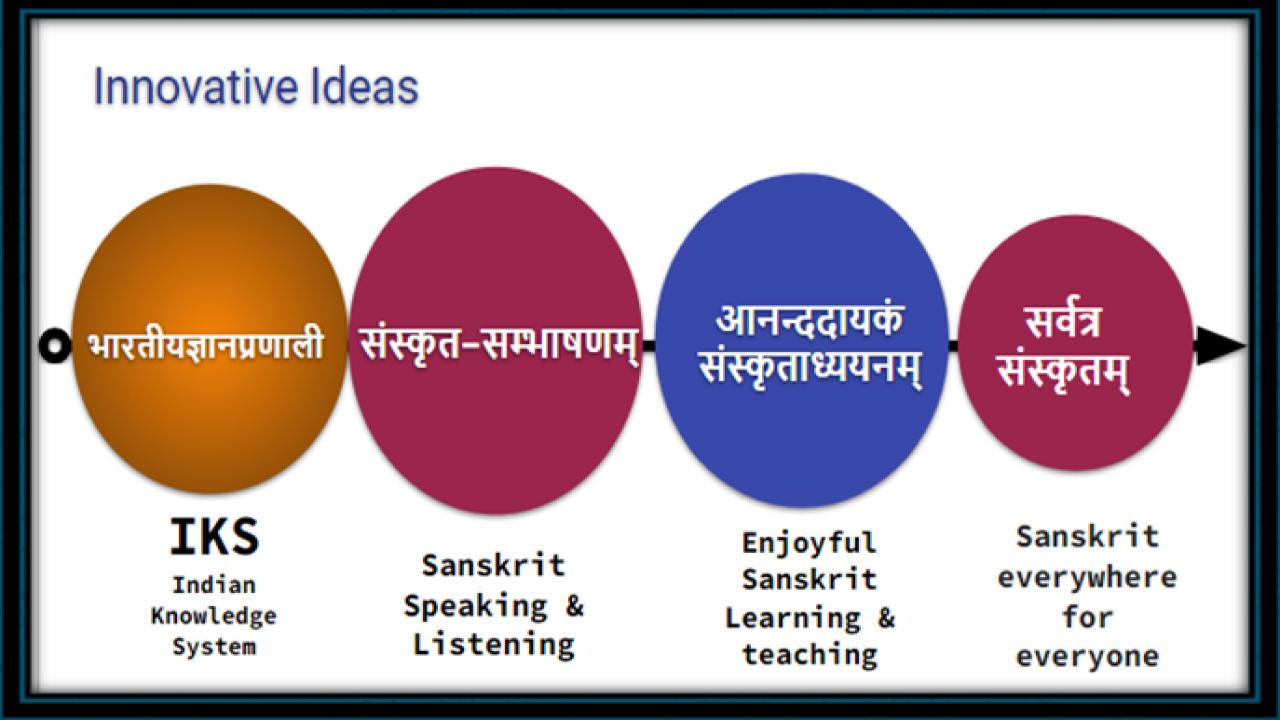
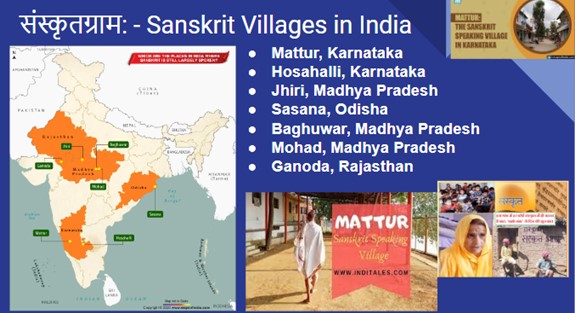
The four skills of language teaching have always been discussed. In the context of Sanskrit language teaching, the first listening skill and the second speaking skill have been completely neglected; due to which even educated people in Sanskrit hesitate to speak Sanskrit. Sanskrit villages are the perfect example to make Sanskrit communicative and useful for the society. From the point of view of language teaching, this is the position of Sanskrit in schools and colleges. The building of a language cannot stand only on the third reading skill and the fourth writing skill. For that, it is necessary to establish and develop all the four skills completely.
N. V. Rajagopalan, propounding the sequence of linguistic teaching, has written- “In second language teaching, it is necessary that first the main skills of the language – listening and speaking are taught and then the secondary skills – reading and writing. Good knowledge of other language’s sound system, pronunciation style, grammatical structure, expressive style, vocabulary etc. is the basis of both types of skills. Therefore, the meaning of teaching another language is to create language proficiency in the learner and to practice the skills of that language gradually. The method of language teaching depends on the structural features of the language, on the one hand, and on the other, linguistic proficiency and skill, both are the goals of the learners.”13
Three attention points in listening skills are:
- Listening calmly,
- Listen with concentration (attention),
- Sufficient listening.
Techniques like reading aloud, question and answer, story-telling and listening, dictation etc. can be used for teaching listening skills. Listening skills can be developed by using audio-visual aids like radio, gramophone, tape recorder and video, various sound instruments and ideal pronunciation etc.
Speaking skill is second among language skills. Speaking skills are used to express our thoughts orally. According to Dr. Uma Mangal- “When a person expresses his thoughts through sounds, with the help of mouth parts, using spoken language, then it is called oral expression.”14 Expressing regret over the ignorance of oral expression in the National Curriculum Framework for primary and secondary level (1985 AD) prepared by N.C.E.R.T, Dr. Kishorilal Sharma said – “It is a matter of sorrow that in our education system and especially in language teaching, there is complete negligence for oral expression. The aspect has been totally neglected.”15 Due to the absence of auditory environment for Sanskrit language, it is natural to be reflecting for the lack of speaking environment.
In the present Indian society, there is often rare Sanskrit atmosphere at home, but an effective teacher should first of all introduce such students to the Sanskrit words contained in their mother tongue, because vocabulary related to Sanskrit is found in all Indian or foreign languages. One special thing to be noted here is that mere utterance is not a speech. Even if we speak some words or sentences by rote, it does not mean at all that our speech skills of that language are developing.
The most appropriate level of teaching pronunciation is the primary level, but this is the biggest obstacle in teaching Sanskrit language, because at the primary level, the system of teaching Sanskrit language is available only at very few places. Sanskrit teaching usually starts from class 6 onwards and at that stage, pronunciation and listening skills are not given as much attention as in the primary classes. A number of techniques can be used to teach oral expression skills. Techniques like conversation, story, reading and poetry recitation, speech, debate and dialogue, acting and dramatization, news reading, language-play, picture reading, etc. are helpful in enhancing proficiency in pronunciation skills.
Many Google applications compatible to android and IOS are available free of cost. These applications are great innovative ideas for Sanskrit learners.
Some links of these applications are given here as an example:
1. Sanskrit Hindi Dictionary
https://play.google.com/store/apps/details?id=org.shrutijha.sanskrit_hindidictionary
2. Sanskrit Hindi Dictionary https://play.google.com/store/apps/details?id=org.shruti.sanskritdictionary
3. Dhatu-Roop-Kalp-Druma
https://play.google.com/store/apps/details?id=org.srujanjha.dhatuvrttis
4. Shabda-Kalp-Druma (Offiline)
https://play.google.com/store/apps/details?id=org.shrutijha.sanskrit_sanskrit_on
5. Shabda-Kalp-Druma (Online)
https://play.google.com/store/apps/details?id=org.shrutijha.sanskrit_sanskrit
6. Shabda-Roop-Mala
https://play.google.com/store/apps/details?id=org.shrutijha.shabdroopmala
7. Vachaspatyam
https://play.google.com/store/apps/details?id=com.srujanjha.vachaspatyam
8. Ashtadhyayi
https://play.google.com/store/apps/details?id=org.srujanjha.ashtadhyayivarnanukramanika
9. Pustak Sandarshika
https://play.google.com/store/apps/details?id=com.srujanjha.upss_library
10. Panini Ashtadhyayi
https://play.google.com/store/apps/details?id=org.srujanjha.paniniashtadhyayi
11. Dhatu-Roop-Mala
https://play.google.com/store/apps/details?id=org.srujanjha.dhatuvrttison
12. Edunet
https://play.google.com/store/apps/details?id=org.srujanjha.quizapp
13. Siddhant Kaumudi
https://play.google.com/store/apps/details?id=org.srujanjha.siddhantakaumudi
14. Amarakosha
https://play.google.com/store/apps/details?id=org.srujanjha.amarkosh
15. Ashtadhyayi Chandrika
https://play.google.com/store/apps/details?id=com.srujanjha.ashtadhyayichandrika
16. Vidyalaya Pradarshak App
https://play.google.com/store/apps/details?id=org.shruti.schoollocator
17. Shabdkosh
https://play.google.com/store/apps/details?id=org.shruti.hindishabdkosh
18. Sanskrit Sachitra Kosha
https://play.google.com/store/apps/details?id=com.srujanjha.visualhindidictionary
19. Kridant Roop Darshika
https://play.google.com/store/apps/details?id=org.shrutijha.kridantroopadarshika
20. Kridant Sadhika
https://play.google.com/store/apps/details?id=org.shrutijha.kridant
21. Vaiyakaran Siddhant Kaumudi
https://play.google.com/store/apps/details?id=org.srujanjha.siddhantkaumudibook
22. Sanskrit Swayam Shikshak
https://play.google.com/store/apps/details?id=org.srujanjha.learnsanskrit
23. Sanskrit Chitra-Bodha
https://play.google.com/store/apps/details?id=org.srujanjha.chitrakoash
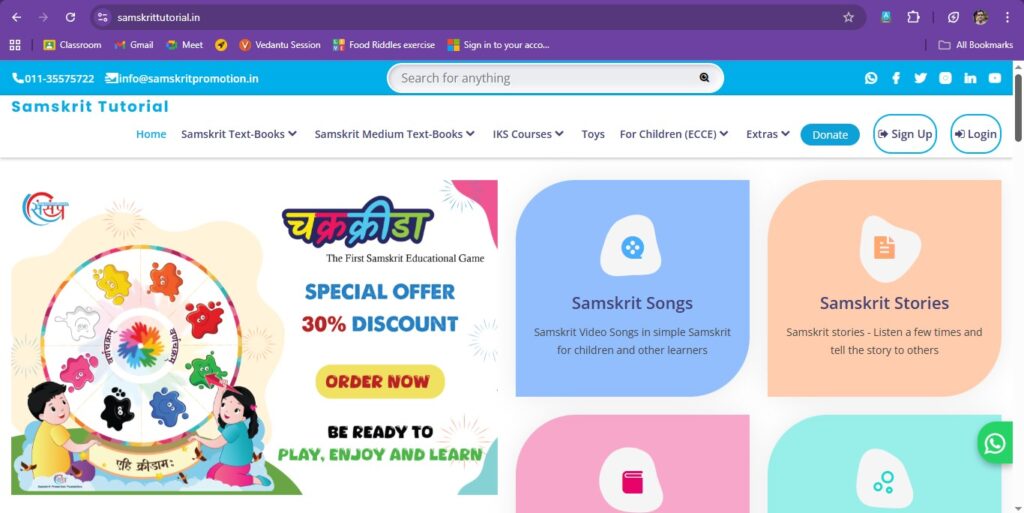
Now we can see many platforms are developing new approach to learn Sanskrit. Such as Sanskrit Promotion Foundation16, Sanskrit through Correspondence17, Adyapananam18, Sanskrit Olympiad19, Learn Sanskrit20. Sanskrit tutorial is also renowned platform to learn Sanskrit. Here anyone can register free to learn Sanskrit through Sanskrit.
“There is a misconception that Sanskrit language is only a language for chanting mantras in temples or religious ceremonies. That, actually, is less than 5% of the Sanskrit literature, more than 95% of which has nothing to do with religion.” Said by Markandeya Katju, Judge, Supreme Court of India on 13.10.2009 in the Indian Institute of Science Bangalore.21 The present society is unaware of the practical usage of Sanskrit; however, according to the 2011 census of India, the number of Sanskrit speakers in India is 10,04,135.22
V. Conclusion
In conclusion, it can be said that in the context of the educational results of Sanskrit language, the current education system is failed to achieve the desired results. The biggest reason for this is the unscientific usage of the rules and principles of linguistic teaching. Non-scientific teaching of a scientific language like Sanskrit has reduced the importance and utility of Sanskrit in the society. Though some organizations established an effective Sanskrit environment, but the country like India needed more to make a wide approach. Therefore, in order to achieve excellent results in Sanskrit language teaching, there is an absolute need for the teacher-student and society to be self-educated for ideological and practical and mainly educational resources and methods. Innovative tools and techniques will be definitely useful for communicative Sanskrit.
REFERENCES
- [1] https://www.hindustantimes.com/india/sanskrit-is-second-official-language-in-uttarakhand/story-wxk51l8Re4vNxofrr7FAJK.html
- [2] https://himachal.nic.in/WriteReadData/l892s/10_l892s/THE%20HIMACHAL%20PRADESH%20OFFICIAL%20LANGUAGE%20ACT,%201975-83509367.pdf
- [3] https://samskritabharati.in/
- [4] https://www.samskritpromotion.in/
- [5] https://sanskrit.nic.in/
- [6] https://en.wikipedia.org/wiki/Sanskrit
- [7] On Interpreting India’s Past (1996) – Prof. Amartya Sen, Asiadtic Society, Kolkata, Preface
- [8] Acharya Narendra Dev – Janvaani
- [9] Dr. Raghunath Safaya – Sanskrit Shikshan pg 62, 93-94
- [10] https://www.education.gov.in/sites/upload_files/mhrd/files/NEP_Final_English_0.pdf
- [11] Tribune India News Service, 30th July 2020 www.tribuneindia.com/news/schools/new-education-policy-wants-rich-sanskrit-to-start-at-primary-level-120017
- [12] Hindustan Times, 29th July 2020
www.hindustantimes.com/education/new-education-policy-2020-focus-on-sanskrit-indian-languages-in-nep-institute-of-translation-to-be-set-up/कहानी-PCNNE7yZVwcXnxfJ22ddlL.html - [13] Language teaching & Linguistics (1989 AD) – N.V. Rajgopalan, pg 11
- [14] Hindi Shikshan (1996 AD) – Dr. Uma Mangal, pg 41
- [15] Hindi Shikhan Pravidhi (1987 AD) – Dr. Kishorilal Sharma, pg 106
- [16] https://www.samskritpromotion.in/
- [17] https://www.samskritashikshanam.in/
- [18] https://adhyapanam.in/
- [19] https://www.sanskritolympiad.in/
- [20] https://www.learnsanskrit.org/
- [21] https://www.outlookindia.com/website/story/sanskrit-as-a-language-of-science/262393
- [22] CENSUS OF INDIA 2011, PAPER 1 OF 2018 LANGUAGE INDIA, STATES AND UNION TERRITORIES (Table C-16), OFFICE OF THE REGISTRAR GENERAL, INDIA 2A, MANSINGH ROAD, NEW DELHI 110011 Pg. 9
Dr. Ashutosh Pareek
Professor, Department of Sanskrit, SPC Govt. College, Ajmer, Rajasthan, Bharat
Visiting Faculty, Hindu University of America, Orlando, Florida, US
Associate Board Member, WAVES International
Website: https://ashutoshpareek.com
Email: namaste.ashutoshpareek@gmail.com